A collaborative folding fan: keep carving, painting and calligraphy credited
A finished object can look unified while carrying work by several named people. A documented Chinese folding fan makes that collaboration visible through carved frame, painted surface and calligraphy. Build a contribution map that preserves those roles instead of letting the most prominent name absorb every part of the object’s making.
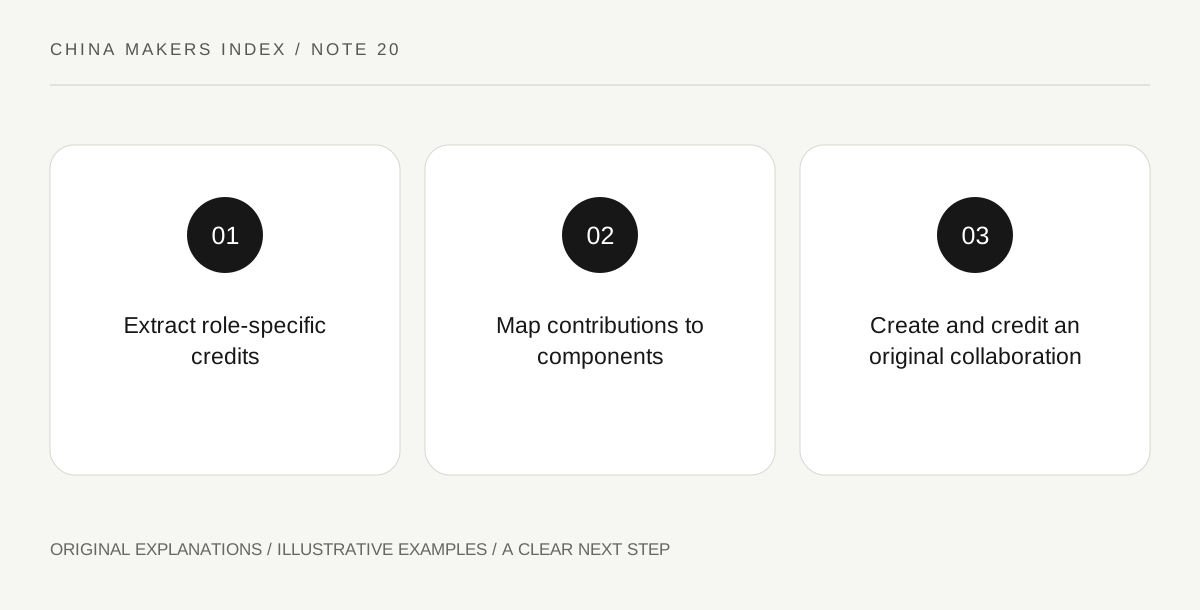
Original explanatory diagram. Read the full method and limitations below.
Read the record for roles, not just names
The Met’s 1924 Carved fan, grapevines and calligraphy credits bamboo carving to Jin Xiya, painting to Jin Cheng and calligraphy to Chen Baochen. Keep each name beside the stated role. A single object title does not imply a single maker, and one celebrated contributor should not silently replace the others. Begin with a three-column map: component or surface, kind of work and credited person. This makes the record easier to read and gives practical shape to the idea of collaboration.
Locate contributions on the object
Use the museum’s authorized views and description to connect each credited role with the relevant part. If a side or detail is not visible, note that the identification comes from the record rather than from direct inspection of the image. Do not guess which handwriting belongs to whom based only on visual prominence. The map is useful precisely because physical location and attribution are different kinds of information. Bringing them together carefully explains how a unified object can preserve several distinct skills and voices.
Make an original collaboration with explicit boundaries
For a small learning exercise, ask consenting collaborators to work on separate parts of an ordinary paper card: one designs a border, another draws an invented plant and another adds an original short phrase. Agree on the space and credit before starting. The result is not a traditional folding fan and should not be presented as a copy of the museum object. Its purpose is to reveal a practical collaboration question: how do separate contributions coexist when they share one limited surface?
Write the finished credit as carefully as the design
Create a caption that names each contribution and contributor, and obtain permission before publishing another person’s work or identity. Preserve any limits they request. If you alter a contribution later, record the change instead of pretending the original collaborator approved it. Return to the museum fan and notice how the contribution map changes your attention. The frame is no longer merely a support for a picture, and calligraphy is no longer anonymous decoration. Good credit is part of understanding the object’s structure of work.
Illustrative design exercise
Illustrative collaboration: three adults agree to make one paper card. One supplies a border, one an invented vine drawing and one an original phrase. They settle the boundaries before beginning and approve a caption naming the roles. The learner then compares this small teamwork experience with the museum fan’s documented credits, preserving the difference between an original card exercise and a historical multi-artist craft object.
Questions that come up
Should the object be attributed only to the most famous contributor?
That would erase documented work. Use the museum’s role-specific credits and preserve uncertainty where the record does not identify a contribution.
Does a shared surface require everyone to use the same style?
Not necessarily. The exercise concerns coexistence and agreed boundaries, not mandatory uniformity. The collaborators can discuss how their separate contributions relate.
References and scope
These sources support the factual background. Examples and exercises are original illustrative teaching material. References do not imply endorsement.
- The Met: Carved fan, grapevines and calligraphy, 2020.338 — The 1924 fan’s named carving, painting and calligraphy contributors and paper/carved-bamboo medium; original collaboration exercise.