Dough figurines: establish a gesture before adding tiny details
A miniature figure can carry a recognizable action before it has a detailed face or elaborate clothing. Studying dough figurines through gesture helps a beginner understand how much design happens at the level of body arrangement. An original paper exercise makes that question accessible without pretending that a simple drawing replaces a skilled modeling tradition.
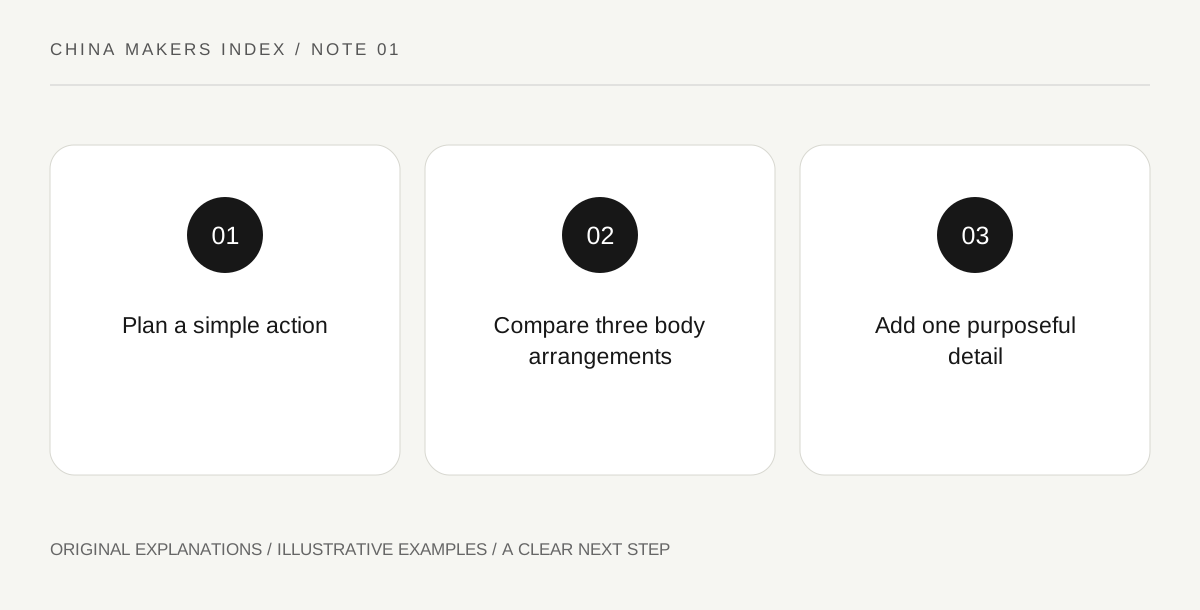
Original explanatory diagram. Read the full method and limitations below.
Begin with a documented practice
Beijing’s official cultural account describes dough-figurine artists shaping colored dough into miniature human and animal forms, with contemporary subjects entering the practice. Use that account to identify the craft, then focus your own study on one design question: how is action communicated? A recognizable character and a readable gesture are related but different achievements. Costume may tell you who a figure represents, while the arrangement of body parts suggests what is happening. A beginner can learn to separate those questions before trying to reproduce a complex subject.
Reduce the pose to three relationships
On ordinary paper, draw a head position, a trunk direction and the line of an arm or other active part. Use a fictional character doing a simple task such as offering a box. Make three versions by changing one relationship at a time. The exercise is original pose planning, not a traditional recipe or a claim that every artist works in this sequence. Ask which arrangement communicates the task most clearly without facial detail. This makes the underlying design decision visible and keeps the exercise manageable for someone with little drawing experience.
Add detail only when it has a job
Choose one version and add a prop, a clothing edge or a facial direction that strengthens the action. If a detail only makes the page busier, leave it aside for another study. In a workshop, ask the instructor how a modeled element is supported and connected instead of assuming that every decorative addition is independent. Follow the supplied materials and instructions rather than improvising a preservation recipe from a cultural article. The important beginner lesson is how a small addition changes the relationship already established by the pose.
Credit the tradition and your own exercise differently
When sharing the result, identify the documented craft that prompted the question and describe the paper study as your own learning exercise. Do not present a first attempt as a traditional masterwork or copy an identifiable contemporary artist’s character design while claiming originality. A useful caption says what you explored: three body arrangements for one invented action. That is specific enough to show learning and modest enough to leave the professional skill of dough modeling visible. The exercise can prepare you to watch a demonstration with more informed attention.
Illustrative design exercise
Illustrative study: a learner draws an invented figure offering a square parcel. In one version the head turns away, in another the body leans back, and in a third the head and arms support the offering action. The learner selects the third and adds only a simple sleeve edge. The caption calls it a paper gesture study inspired by observing the documented craft, not an authentic dough-figurine reproduction.
Questions that come up
Does a paper gesture study teach dough modeling?
It teaches one design question that can improve observation. Material preparation, support, joining and finishing require their own instruction and cannot be inferred from the drawing.
Must every figurine depict a historical subject?
The cited cultural account discusses contemporary subjects as well. The relevant question is how the particular artist develops the practice, not a rule that it must remain visually unchanged.
References and scope
These sources support the factual background. Examples and exercises are original illustrative teaching material. References do not imply endorsement.
- Beijing Overseas Cultural Exchange Center: The Creative Mind & Dexterous Hands — Colored dough modeled into miniature forms and contemporary development of the documented practice; original gesture exercise.