A handmade shuttlecock: ask what balance means to the maker
A decorative feather arrangement can also be part of an object intended to move. A handmade shuttlecock therefore raises questions about balance, assembly and intended use. Study those questions through a maker’s explanation and a simple paper layout, while avoiding the assumption that an attractive display object is automatically suitable equipment for play.
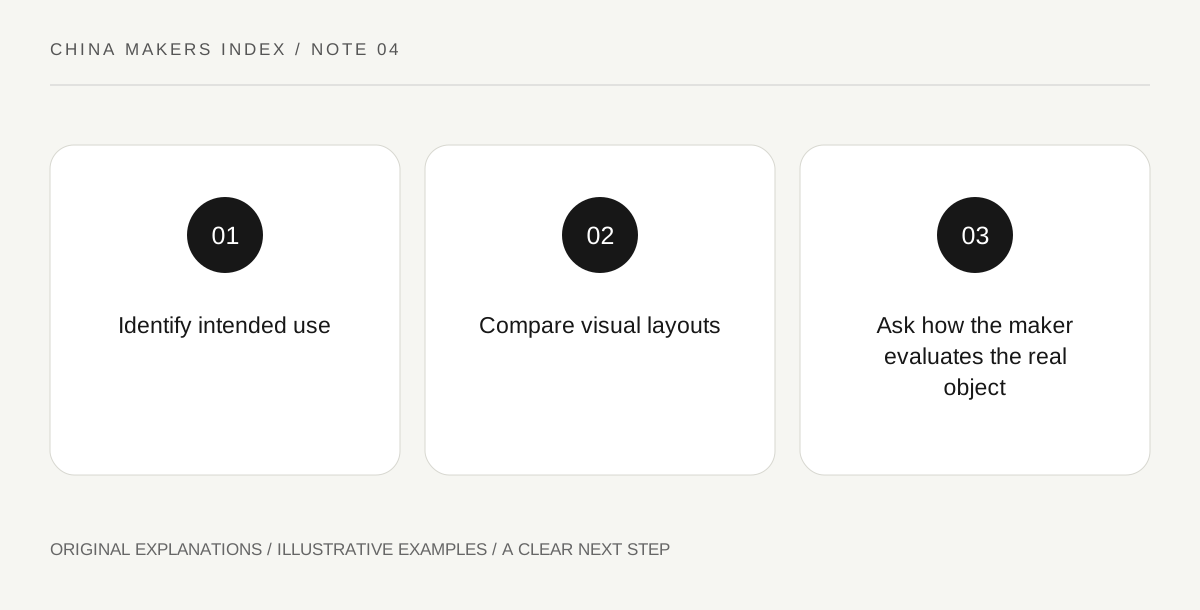
Original explanatory diagram. Read the full method and limitations below.
Keep the specific craft context
Beijing’s official heritage guide describes a shuttlecock-making tradition in which selection and preparation contribute to balance and control. Use that source to recognize the making question, without turning its account into a universal specification for every shuttlecock. Ask which type of object you are looking at: a demonstration piece, an item intended for play or a souvenir. The answer affects what further information matters. Appearance alone cannot establish durability, behavior in motion or suitability for a particular activity.
Map placement without claiming performance
Draw a center point on paper and place four simple paper shapes around it as an original layout exercise. Try equal spacing, a deliberate gap and one shape extended farther outward. Compare the visual balance of the drawings. This does not simulate flight or establish a functional design. The distinction matters because a page can look balanced while a physical object behaves differently. The exercise prepares a useful workshop question: which properties beyond visible arrangement does the maker consider when assembling the real object?
Ask about the role of each component
During a suitable demonstration, identify the base, attachment area and upper arrangement using the maker’s terms. Ask how parts are selected for the intended object rather than requesting an unsupported guarantee about every material. Do not pull at attachments or bend elements to test them without permission. A good question invites an explanation of choices: why this placement, why this combination, and how is the result evaluated? The answer can reveal practical knowledge that a finished display label may not have space to communicate.
Record use claims with their source
If you buy an object for play, obtain the producer’s actual use and care information and choose a setting appropriate to the activity. If you buy it for display, keep that purpose explicit. Do not publish an untested claim that a decorative object performs to a particular standard. A balanced craft note includes the maker’s stated intention, your observed arrangement and the limits of the paper analogy. It gives the object’s practical design enough attention while preserving the difference between appreciation and a product-performance test.
Illustrative design exercise
Illustrative balance card: a learner makes three paper arrangements around a central point and notes which looks visually even. At a workshop, the maker explains that the real object’s evaluation involves more than the drawing can show. The learner records that explanation with attribution and labels a purchased piece according to its stated purpose, rather than treating the prettiest arrangement as proven sporting equipment.
Questions that come up
Does symmetrical appearance prove functional balance?
No. A visual layout is only one observation. Physical behavior depends on properties and assembly that a drawing does not test.
Can a souvenir be used for play automatically?
Do not assume that. Ask the producer about intended use and follow the actual information supplied for the item.
References and scope
These sources support the factual background. Examples and exercises are original illustrative teaching material. References do not imply endorsement.
- Beijing heritage guide: Tang Qian Yan shuttlecock-making — The documented shuttlecock craft’s attention to selection, preparation, balance and control; no performance guarantee.