Silk figurines: distinguish a garment’s surface from its volume
A clothed miniature is more than a silhouette covered with decoration. Its costume has edges, folds and a relationship to the supporting body. Study those relationships through a paper overlay exercise, then use the questions to look more carefully at a documented silk figurine without assuming that every visible form is made from one material.
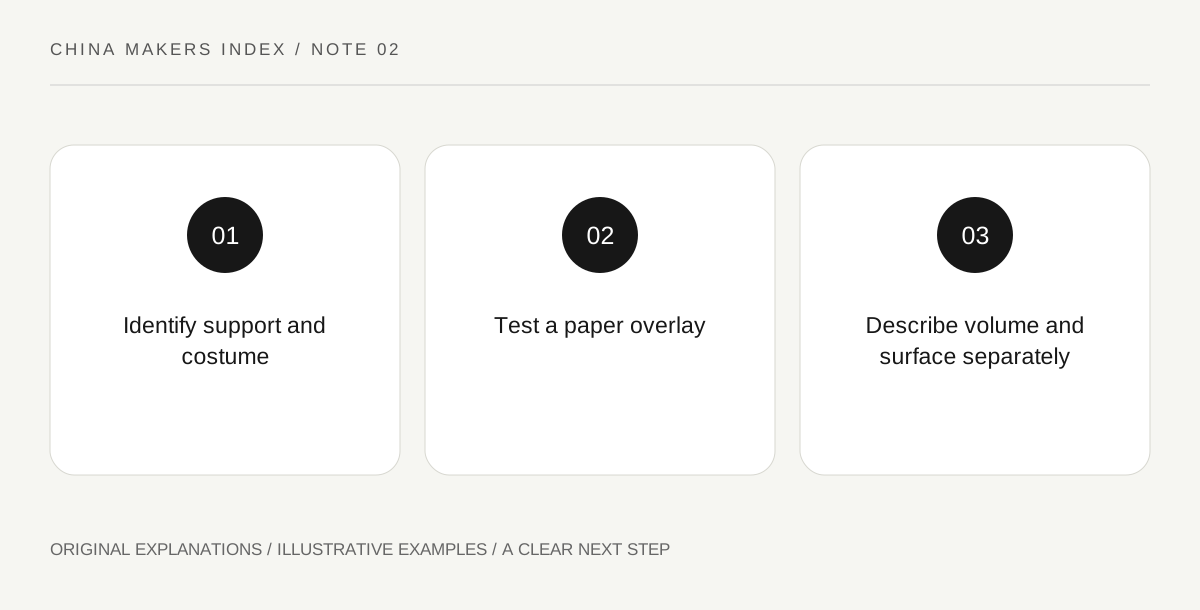
Original explanatory diagram. Read the full method and limitations below.
Read the material line before the costume
Beijing’s official gift-craft account describes silk figurines using several materials and making operations. That is a reminder to separate the figure’s support from the textile appearance that first attracts attention. A named craft may foreground one material while the object is an assembly. In a museum or demonstration, ask which component forms the body, which creates garment volume and which supplies surface detail. Record only what the interpretation or maker actually identifies. A photograph alone may not reveal the concealed support.
Make a flat base and a loose overlay
For an original analogy, draw a simple standing figure on paper and place a second paper shape over it as an imagined coat. Do not glue it immediately. Shift the overlay outward at one side, lower its hem or open a gap near the arm. Observe how the figure changes even though the base has not moved. The exercise isolates the role of the garment outline. It does not reproduce traditional silk construction, and it requires no claim that an artisan builds a figure in the same order.
Give folds direction rather than decoration alone
Add a few drawn lines to the overlay and ask what each line suggests about the garment’s direction. A line that curves around the body communicates something different from an unrelated surface motif. Keep the number small enough to discuss individually. When studying a real object, distinguish the visible folds from painted or embroidered patterns if the record allows it. Do not assign a textile technique because a line looks thread-like in a small image. The exercise’s value is learning to ask how volume and surface cooperate.
Write a layered caption
Finish with three short descriptions: body arrangement, garment volume and surface detail. Attach material identifications to the component they concern. If a record simply says mixed materials, preserve that limitation rather than filling in every hidden element from your analogy. A layered caption is useful when comparing two figurines whose costumes look similar but whose posture or volume differs. It also prevents an elaborate textile surface from making the supporting work disappear from the story of the object.
Illustrative design exercise
Illustrative overlay: a learner draws one stationary base figure and tries three paper coats. A wider sleeve changes the apparent gesture, while a lower hem changes the balance of the silhouette. Three purposeful lines suggest how the coat falls. The final caption separates the imagined support from the garment shape and pattern, explicitly labeling the page as a paper design analogy rather than a silk-making method.
Questions that come up
Is a silk figurine necessarily made entirely of silk?
A craft name does not establish every component’s material. The cited account describes an assembly, so use the particular object’s record or maker’s explanation.
Can a fold and a painted line look similar in a photograph?
Yes. Limited images can obscure the difference. Keep uncertain observations descriptive and consult a material or technique record before naming the process.
References and scope
These sources support the factual background. Examples and exercises are original illustrative teaching material. References do not imply endorsement.
- Beijing magazine: Beijing Gifts, November 2025 — The documented silk-figurine practice as a multi-material assembly; no complete construction or material formula.