An abacus: see the craft object as a record of changing states
An abacus is both a made object and a surface for representing changing information. Studying it only as rows of decorative beads misses that relationship. Use a documented Chinese zhusuan reference to distinguish the physical frame from the rules of interpretation, then try an original paper-state exercise that requires no claim of instant calculation mastery.
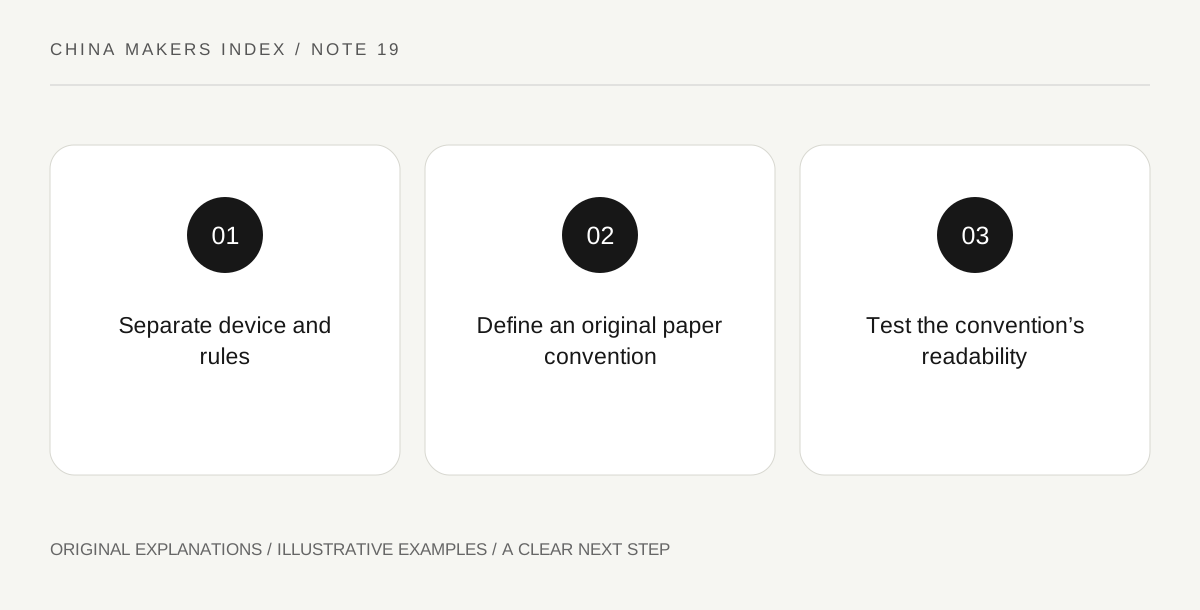
Original explanatory diagram. Read the full method and limitations below.
Separate hardware from the practiced knowledge
UNESCO describes Chinese zhusuan as calculation through moving beads according to defined rules and emphasizes its transmission as knowledge and practice. The physical object supports that work, but a photograph of beads does not automatically teach the rules. Write frame and components on one line, state and interpretation on another. This distinction explains why two images of the same abacus can convey different information without the object itself being remade. The craft of the supporting device and the learned calculation practice are connected subjects, each deserving its own attention.
Invent a simple paper state system
Draw three vertical tracks and place one movable paper marker beside each. Define your own explicit rule, such as a marker near the top meaning selected and one near the bottom meaning unselected. This is an original binary layout exercise, not a traditional abacus or zhusuan lesson. Show two different marker arrangements and write the meaning of each using the rule you defined. The narrow goal is to understand how position can carry information when a shared convention makes the positions readable.
Test whether another person can read the rule
Give a companion the rule and the two drawings without explaining them verbally. Ask them to describe the states. If they cannot, revise the labels or orientation rather than blaming the reader. A functional representation depends on more than visible components: the convention must be clear enough to apply. This exercise does not measure intelligence or promise mental-arithmetic benefits. It studies communication between a made layout and its reader. Traditional calculation competence requires appropriate instruction and practice beyond this small analogy.
Return to the documented object with better questions
When looking at an abacus, ask how its physical organization supports the practiced rules identified by the source. Keep any explanation attached to the particular type of device or lesson. Do not assume every bead layout across all traditions follows the same convention. Finish by describing one physical feature and the kind of rule question it raises. That account respects both craft and knowledge, avoiding the idea that an object can be understood completely either through its attractive materials or through a calculation result divorced from the device.
Illustrative design exercise
Illustrative state exercise: a learner defines three paper tracks as three separate choices, with top meaning selected. A companion reads one arrangement correctly but reverses the orientation of the second. Adding a clear top label resolves the ambiguity. The learner calls it an invented position-and-rule study and then seeks proper instruction to understand an actual abacus rather than presenting the paper system as zhusuan.
Questions that come up
Does moving paper markers teach traditional abacus calculation?
No. It illustrates position-based representation only. Actual zhusuan rules, techniques and competence require their own instruction and practice.
Can a bead photograph be read without knowing its convention?
Not reliably. Components and positions need a relevant rule system, and different devices or traditions should not be assumed interchangeable.
References and scope
These sources support the factual background. Examples and exercises are original illustrative teaching material. References do not imply endorsement.
- UNESCO: Chinese Zhusuan, knowledge and practices of mathematical calculation through the abacus — Calculation through moving beads under defined rules and the transmission of knowledge; no cognitive-benefit or instant-mastery claim.