A jade pendant: compare the outer contour with the inner spaces
A small carved pendant is shaped by the material that remains and the spaces opened within it. Study those two outlines separately using a documented Chinese jade example. An original paper drawing reveals how an inner gap can change the reading of a creature-like form without requiring stone carving or claims about the object’s authenticity.
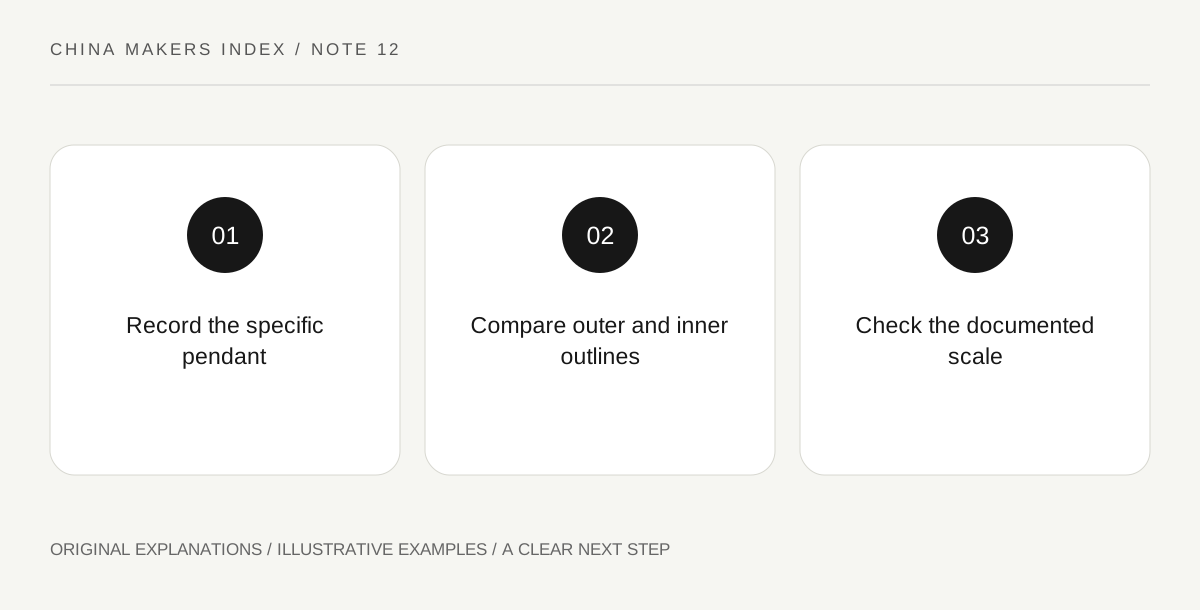
Original explanatory diagram. Read the full method and limitations below.
Use a particular object record
The Met identifies its Pendant in the shape of a coiling dragon as Chinese nephrite from the Shang period. Let that record supply the object’s material and historical identification. Your visual exercise does not establish either. Start with a simplified outer contour based on the kind of curved form you are studying, then make a separate drawing of the visible internal spaces. Keep the museum object’s name and number nearby so the study remains attached to a specific source rather than a generic image labeled ancient jade.
Draw a shape and its missing area
Invent a broad curling shape on ordinary paper and shade it as a single solid area. On a second version, introduce one inner gap with a pencil outline, leaving the page intact if you do not want to cut anything. Compare how the gap changes the apparent direction and openness of the form. This is an original negative-space exercise, not a reconstruction of a traditional carving method. The key is that an absence can carry design information just as an added line can.
Separate a visible opening from its function
A hole or gap may invite a question about suspension, assembly or composition, but appearance alone cannot determine its historical use. Read the object’s interpretation and preserve any uncertainty. Do not thread a cord through an antique or handle a display to test an imagined wearing arrangement. In your own paper drawing, you may mark a hypothetical suspension point, but label it as a design proposal for that invented shape. The distinction keeps a useful functional question from turning into an unsupported historical claim.
Scale the drawing back to the recorded size
Museum images can make a small object appear monumental. Consult the stated dimensions and sketch a separate approximate outline at that scale, clearly marked as approximate. Notice which details remain easy to discuss and which depend on an enlarged view. Keep measurement information attributed to the record rather than claiming to have measured the object yourself. Finish with two observations: one about the outer contour and one about an inner space. Together they provide a more complete account than a surface-pattern description alone.
Illustrative design exercise
Illustrative comparison: a learner invents a curling animal-like outline and draws one version solid and another with a central opening. The second reads as more open, though both use the same outer contour. A third sketch roughly matches the museum record’s stated scale. The learner labels a proposed hanging point as hypothetical and keeps the documented pendant’s history separate from the paper design.
Questions that come up
Does a visible hole prove how a pendant was worn?
It raises a functional question but does not answer every historical detail. Use the specific object’s interpretation and avoid inventing an arrangement from appearance alone.
Can a paper exercise teach jade carving?
No. It isolates shape relationships. Working stone requires specialist knowledge and equipment that the drawing does not provide.
References and scope
These sources support the factual background. Examples and exercises are original illustrative teaching material. References do not imply endorsement.
- The Met: Pendant in the shape of a coiling dragon, 2019.193.1 — The object’s Chinese nephrite identification, Shang-period attribution and recorded dimensions; original negative-space study.