A jade snuff bottle: notice the junction between body and stopper
An elegant small container can combine materials that are easy to merge into one impression. Study a documented jade snuff bottle by focusing on the junction between its body and stopper. The exercise is about assembly and visual contrast, keeping a historical object study separate from tobacco use, valuation or a claim to authenticate a similar-looking purchase.
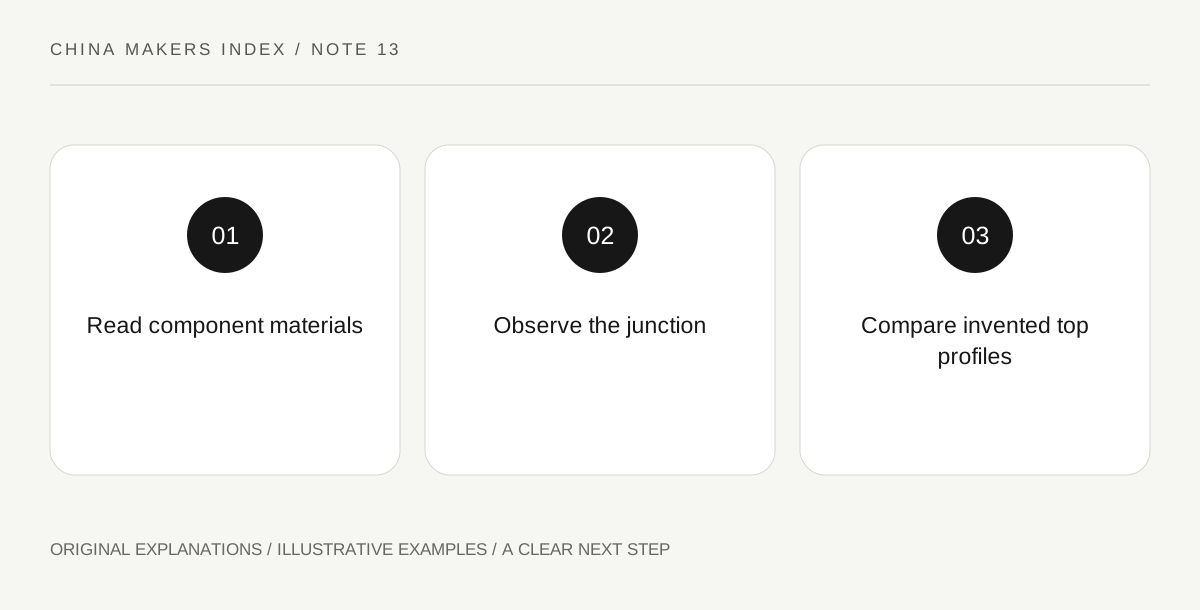
Original explanatory diagram. Read the full method and limitations below.
Read the material record in parts
The Met identifies one Qing snuff bottle as nephrite with an agate stopper. That short record already contains a design lesson: the material name applies to particular components, not uniformly to the whole object. Draw two boxes labeled body and stopper and place the documented materials in the right boxes. Do not infer a stopper’s material solely from its color or transfer the museum identification to another bottle. The exercise begins with a specific record and keeps its factual scope attached to that object.
Find the visual junction
In an authorized image or display, identify where the body’s outline meets the stopper assembly. Describe how the transition is emphasized or subdued, using the view actually available. A contrast in tone or shape can draw attention to the junction, but it does not reveal the hidden attachment method. If the record does not explain how parts connect, leave that field unknown. A small object can be visually continuous while still depending on several components whose construction history is not apparent from the main photograph.
Invent three stopper silhouettes
For an original paper study, draw one simple bottle body and add three alternative stopper profiles. Keep the body stable so you can see how a low, tall or wider top changes the whole silhouette. Use invented colors to explore contrast without naming them as real stones. The drawing is not a restoration proposal for the museum object. It isolates the design role of a component that might otherwise be dismissed as a minor accessory. Ask which version makes the junction conspicuous and which lets the body dominate.
Preserve component history as a question
Historical objects may have research questions about dating, provenance and assembly that cannot be solved by visual harmony. Do not assume that two parts were made together because they look well matched, or that a mismatch proves a recent replacement. Those conclusions need object-specific evidence. Finish with the museum identification, one observed junction relationship and one open construction question. The result explains more than an adjective such as precious while avoiding an appraisal or authentication claim that a beginner’s sketch cannot support.
Illustrative design exercise
Illustrative silhouettes: a learner draws one invented oval body with three differently proportioned tops. A wide top changes the perceived balance, while a low one makes the body more prominent. The exercise uses colored pencils without labeling them as actual gemstones. Beside it, the museum object’s nephrite-body and agate-stopper record remains a separate factual entry, with attachment history left unanswered.
Questions that come up
Does visual harmony prove a stopper is original to a bottle?
No. Appearance alone cannot establish component history. Such a conclusion requires appropriate research about the actual object.
Does this study require handling or opening a historical container?
No. Use authorized views and object records. Do not manipulate a display or collectible to test an imagined assembly.
References and scope
These sources support the factual background. Examples and exercises are original illustrative teaching material. References do not imply endorsement.
- The Met: Snuff Bottle, 21.175.192a, b — The specific object’s nephrite body and agate stopper identification; no tobacco-use advice or authenticity claim.