Yixing teapots: read the relationship of body, lid, handle and spout
A small teapot can look like one continuous form even though its parts solve different design problems. Use a documented Yixing example to study the relationships of body, lid, handle and spout. A profile exercise makes those decisions visible without pretending that a drawing can establish pouring performance, authenticity or suitability for food use.
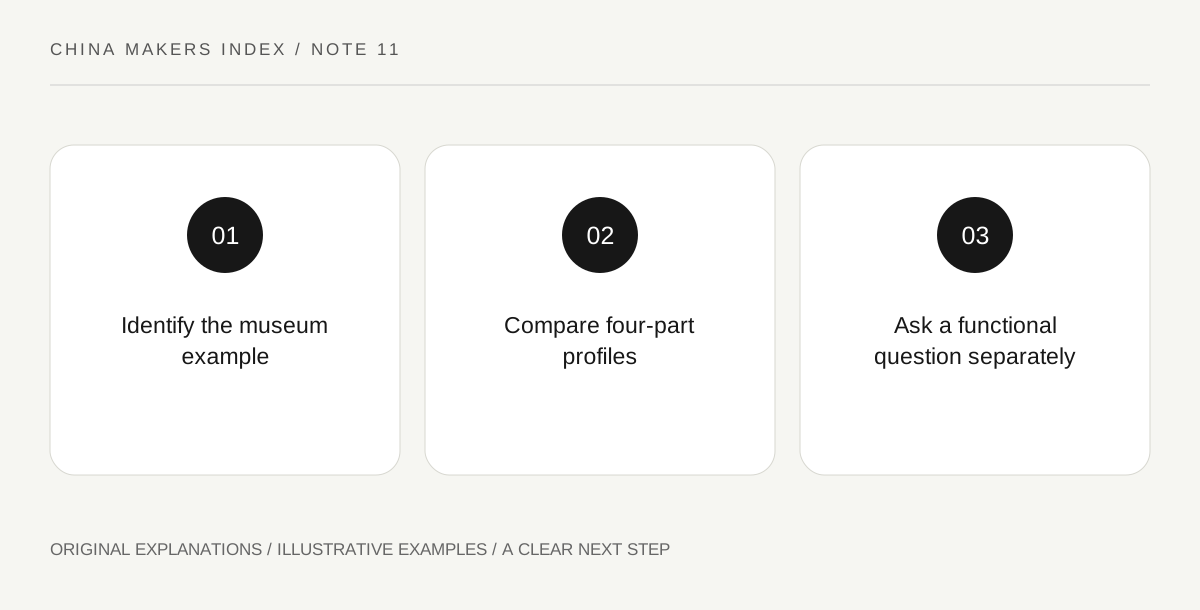
Original explanatory diagram. Read the full method and limitations below.
Begin with the documented example
The V&A’s teapot history identifies early Chinese examples made with Yixing zisha clay and includes a dated Yixing teapot. Use the named example as a specific study object rather than treating every brown pot as Yixing. A color impression is not a provenance or material test. Write the museum identification beside the image you consult, then list the four parts you intend to compare. This keeps a documented object separate from products that merely resemble its broad outline.
Make four parts legible in one profile
Draw a simple invented pot body and add a lid, handle and spout as separate outlines. Change one part while keeping the other three stable. A taller lid or a more extended spout can alter the whole silhouette even when the body is unchanged. This is an original design exercise, not a plan for a working teapot. Keep the variations on one page so the comparison remains clear. The method helps you notice relationships in the museum example without claiming that its maker followed your drawing sequence.
Distinguish appearance from performance
A balanced-looking profile cannot demonstrate how an object pours, how securely a lid fits or whether a handle is comfortable. Those are physical and product-specific questions. At an authorized workshop, ask how the maker evaluates the intended function and which features require checking beyond appearance. Do not test a museum object or an unknown collectible with water or tea. Your paper profile can identify a question about alignment, but it cannot certify a vessel’s condition, material safety or fitness for current use.
Write a comparison that leaves the material visible
Return to the documented example and describe one relationship between two parts, such as the lid’s scale relative to the body. Keep the museum’s material identification in a separate line. That avoids making the craft disappear into pure graphic shape while also preventing a material name from explaining every design choice. Finish with the question you would ask a potter about the relationship you observed. A thoughtful form study is complete when it makes a specific question possible, even if it supplies no purchase recommendation.
Illustrative design exercise
Illustrative profile sheet: a learner draws one invented body with three different lid heights. The tallest lid changes the apparent balance, but the learner labels all three as untested silhouettes. Beside the museum’s identified Yixing example, they write a question about how lid fit is evaluated physically. The page distinguishes design observation, documented material and functional testing instead of allowing one to stand in for the others.
Questions that come up
Does a brown unglazed-looking pot have to be Yixing?
Appearance alone does not establish origin or material. Use a reliable record for the specific object instead of treating a visual resemblance as authentication.
Can I judge pouring quality from a side photograph?
A photograph can raise useful questions about form, but it does not test operation or condition. Functional claims need appropriate evidence about the actual vessel.
References and scope
These sources support the factual background. Examples and exercises are original illustrative teaching material. References do not imply endorsement.
- V&A: Teapot design through time — The documented Yixing zisha teapot context and identified museum example; not authentication or functional certification.