An amber square cup: compare a familiar function with an unfamiliar outline
A cup need not have the circular outline that first comes to mind. A documented Chinese amber square cup offers a way to separate an object’s named function, geometric form and material. A drawing study explores those relationships while leaving historical use, condition and suitability for drinking to appropriate evidence.
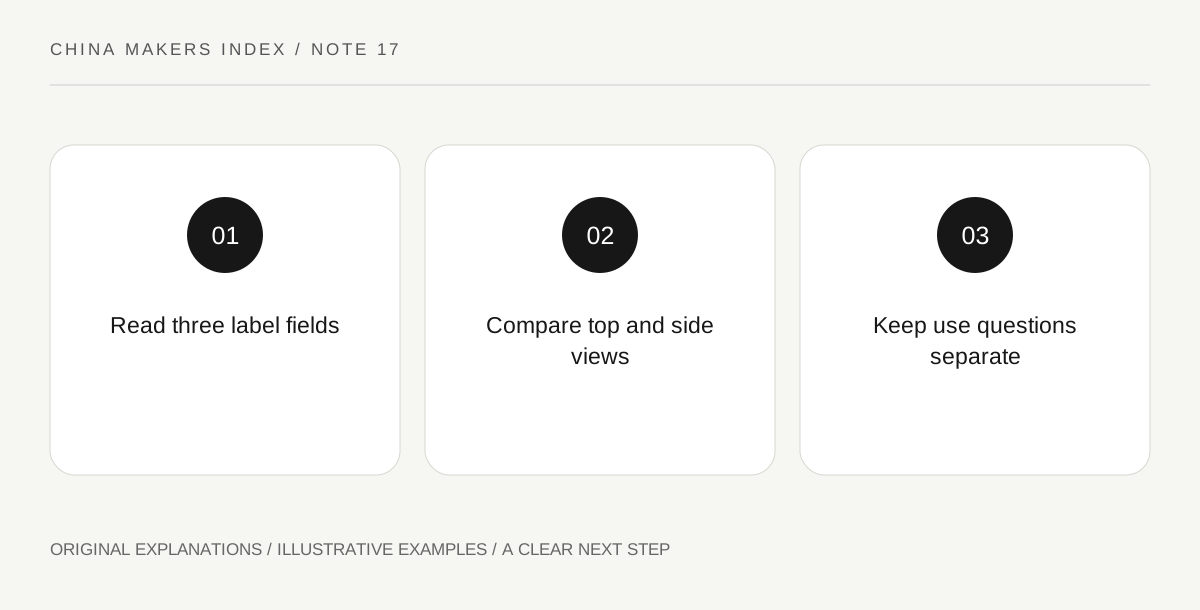
Original explanatory diagram. Read the full method and limitations below.
Read three facts without merging them
The Met records a Chinese Square Cup in amber and attributes it to the Qing Kangxi period. Put title, material and period in separate fields. The title supplies an object category; amber is a material identification; the period is a historical attribution. None tells you every detail about how the object was made or used. Keeping the fields separate helps you recognize how much a short museum label can establish and how much remains beyond it. Your drawing exercise begins from that distinction rather than treating one word as a complete explanation.
Compare top and side as different questions
On paper, draw an invented circular opening and a square-like opening, then add a side profile for each. The top view emphasizes the boundary around the cavity, while the profile emphasizes height and the relationship to a base. Label the drawings schematic. They do not reproduce the museum object’s exact geometry. The comparison simply reveals that a familiar function word such as cup permits more than one form and that a single side photograph may conceal an important difference in the opening.
Do not turn a category into handling permission
A historical vessel classified as a cup is not automatically a current drinking utensil. Its condition, conservation needs and suitability for contact with food or liquid require separate information. Study it through authorized views rather than testing it. In a museum image, observe how the form is presented and which sides are visible. If the interior is hidden, mark that limit instead of completing it from the paper exercise. The model helps you formulate a question, but the actual object remains the source of its own evidence.
Use material as a question about making
Ask what working the identified material might require, then seek a suitable technical source rather than inventing a process from the cup’s shape. A smooth surface can hide labor, while a geometric edge can look simple without being simple to make. Finish with a caption that holds the three facts and one bounded observation together. The result is a specific object study, not a recommendation to buy an antique, an appraisal or a claim that a photograph has revealed the maker’s full procedure.
Illustrative design exercise
Illustrative view pair: a learner draws two invented cups with similar heights but different opening outlines. From the side they seem more alike than from above. The learner then reads the amber object’s record and lists its title, material and period separately. An unseen interior remains unknown, and the caption explicitly avoids treating the historical cup classification as a statement of present-day usability.
Questions that come up
Does the word cup guarantee it is safe to drink from now?
No. Historical classification does not establish present condition or suitability for food use. Those questions require information about the actual object.
Can a side photograph show the complete opening shape?
Not necessarily. Perspective may hide important geometry. Use authorized additional views where available and mark what remains unseen.
References and scope
These sources support the factual background. Examples and exercises are original illustrative teaching material. References do not imply endorsement.
- The Met: Square Cup, 24.80.107 — The Chinese amber square-cup identity, recorded dimensions and Kangxi-period attribution; no usability or process certification.