Chinese bronze vessels: draw the empty space as part of the design
A vessel’s hollow center is easy to overlook because attention goes to its decorated outer wall. A conceptual study of documented Chinese piece-mold casting puts that empty space back into the explanation. Use diagrams to distinguish outer form, wall and inner cavity, with no attempt to turn the lesson into metalworking instructions.
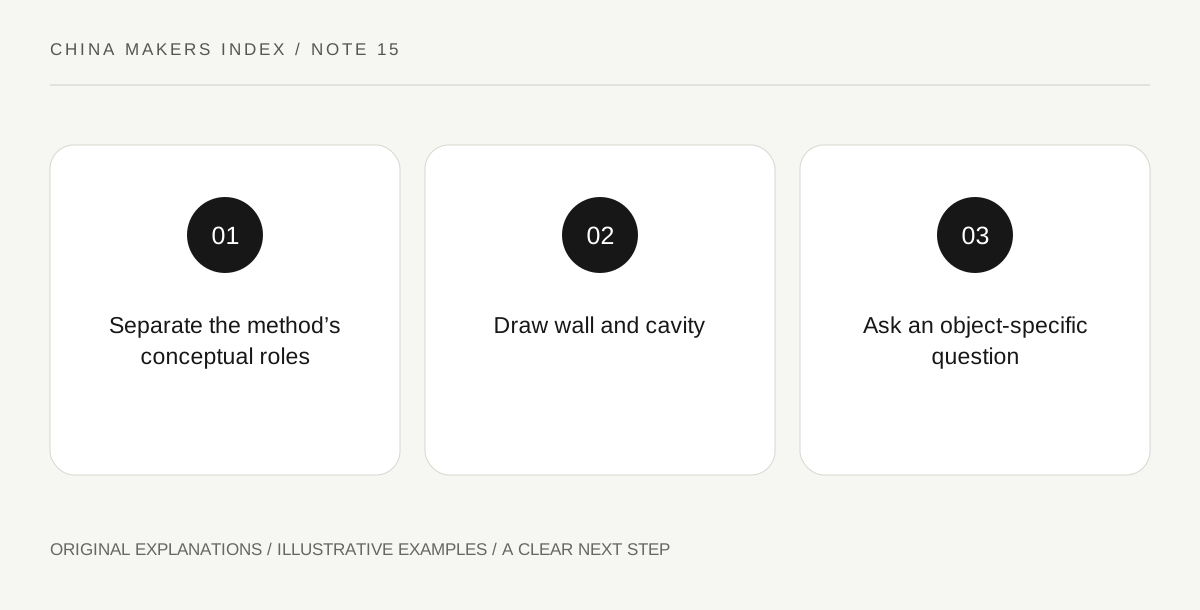
Original explanatory diagram. Read the full method and limitations below.
Read the method at a conceptual level
The Met’s Bronze Age account explains piece-mold casting through a model, sectional molds and, for a hollow vessel, an internal core. Preserve those roles as separate labels. A model describes a desired object, a mold organizes the forming space, and a core helps define the cavity in the account. This brief relationship is enough for the drawing exercise. It is not a workshop specification and supplies no materials recipe, dimensions, temperatures, equipment choice or operational procedure.
Make a three-zone section diagram
Draw an invented cup-like outer outline on paper. Inside it, draw a second outline leaving a visible band between the two. Label the band imagined wall and the central area imagined cavity. Now add a surrounding region labeled outer forming boundary. The drawing is schematic and not to scale. It helps a beginner see why a hollow object requires attention to both inside and outside. The absence at the center is a designed relationship, not merely a hole that appears after the outer decoration is complete.
Change the cavity while holding the outside stable
Make two more versions with the same outer outline and different inner outlines. Compare how the imagined wall band changes. Do not draw conclusions about real structural strength or castability; those require engineering and material knowledge that the exercise does not provide. The narrow lesson is geometric: an exterior photograph does not fully establish the interior form or wall thickness. When studying a museum vessel, consult authorized additional views or technical interpretation rather than filling the hidden interior with your preferred drawing.
Reconnect method with the particular object
A general casting explanation does not automatically identify every process used in every Chinese bronze. Attach any method statement to the object or historical scope the source actually discusses. Keep decoration, vessel form and making method as related but distinct fields. Finish with one question about a documented example that your section diagram helps articulate. That question may concern a cavity, an opening or the relationship of a handle to the main form. A conceptual drawing succeeds by clarifying what needs evidence, not by making a visitor a metal caster.
Illustrative design exercise
Illustrative sections: a learner draws three invented vessels with the same outside profile but different central cavities. The visible wall bands vary, showing why one exterior view cannot supply the hidden geometry. The sheet is labeled conceptual and untested. Beside a museum example, the learner records only the process information actually supplied by the source and leaves its unstated technical details unknown.
Questions that come up
Is the central empty space irrelevant because it contains no material?
No. It is part of the vessel’s designed form. The conceptual section makes its relationship to the surrounding wall visible.
Does this diagram provide casting instructions?
No. It explains a few roles in a documented method and deliberately contains no operational specification. Real casting requires specialist facilities and instruction.
References and scope
These sources support the factual background. Examples and exercises are original illustrative teaching material. References do not imply endorsement.
- The Met: Shang and Zhou Dynasties — The Bronze Age of China — The conceptual model, sectional-mold and core relationships in the described casting account; no production procedure.