Fanhua: compare the closed and opened states of a paper object
Some paper objects are designed to change as they open, making one still view an incomplete account of their form. The documented craft name fanhua offers a starting point for a broader design exercise: compare an object’s compact state with its revealed state, and explain what the movement contributes to the experience.
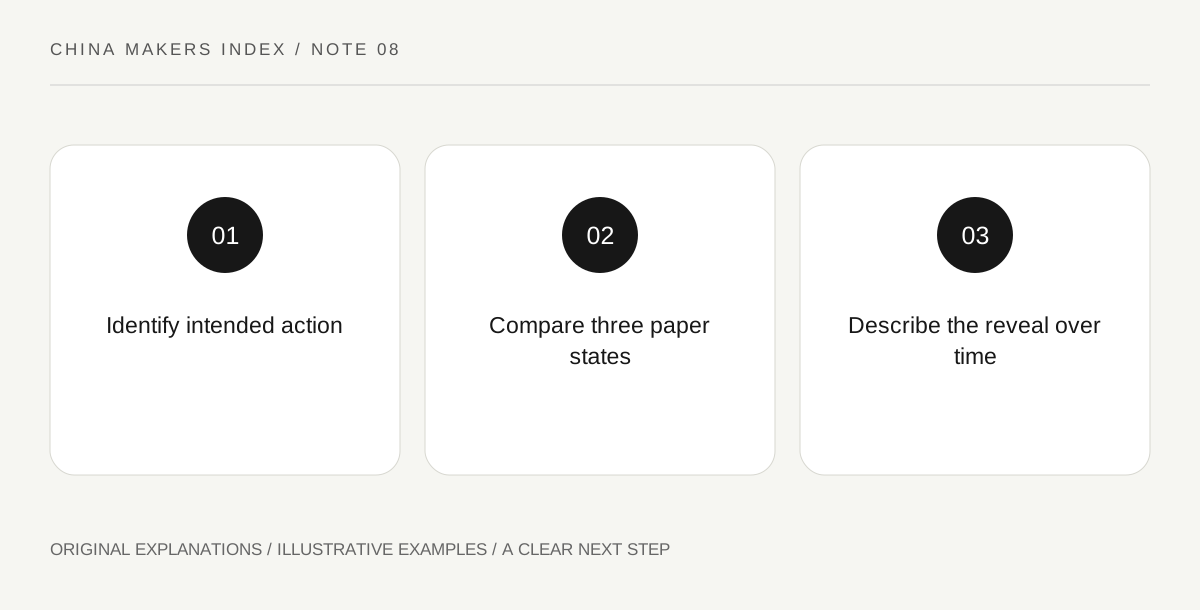
Original explanatory diagram. Read the full method and limitations below.
Begin with a bounded cultural reference
Beijing’s official fair account identifies fanhua as an intricate paper-flower craft among demonstrated folk arts. It does not provide a complete construction specification. Keep that limit clear when using the name as a research prompt. Ask a maker or suitable display for the particular form and its intended action. A translated label may emphasize the flower appearance while leaving the changing paper structure unexplained. The first useful question is what the object is meant to do, rather than how to copy it from a single photograph.
Make a simple original folded-strip study
Use an ordinary strip of paper and fold it back and forth into a loose accordion. Draw a different simple mark on each visible panel, then compare the compact and expanded views. This is an original analogy for changing visibility, not an authentic fanhua pattern. Do not claim that the fold sequence reproduces a documented paper-flower technique. The exercise only makes one design relationship tangible: information visible in one state may be hidden in another, so the movement can be part of the object’s visual composition.
Record the transition as well as the endpoints
Make three small sketches labeled compact, partly open and expanded. Identify which shapes appear first and which remain hidden longest in your invented strip. A two-image comparison shows difference, while the middle sketch begins to explain the transition. In a real demonstration, observe the operator’s intended handling and ask before touching. A transformable object can depend on a particular grip or sequence that a spectator cannot infer safely from the final arrangement. Preserve the maker’s explanation rather than substituting your paper analogy for it.
Describe an experience over time
Write a caption with a beginning, change and result. For the invented strip, the beginning might emphasize a compact stack, the change a sequence of appearing marks, and the result a longer patterned surface. For a documented craft object, use only what you actually observed or what the source states. The distinction makes your account more useful than calling the object simply decorative. It also recognizes a kind of craft intelligence that organizes time and handling, rather than treating the finished open shape as the only part worth discussing.
Illustrative design exercise
Illustrative sequence: a learner marks alternate panels of a folded paper strip with circles and short lines. In the compact view only one mark appears; in the half-open sketch a repeating relationship emerges. The final caption explains the reveal and labels the study as an invented visibility exercise. A later fanhua demonstration is recorded separately, with the maker’s own name for the object and handling action.
Questions that come up
Does a folded-strip exercise teach a traditional paper-flower pattern?
No. It isolates changing visibility as a design question. The particular craft’s materials and construction need their own documented instruction.
Why is a photograph of the fully open object insufficient?
It can show that state clearly, but it omits the transition and handling that may be central to the object’s experience. A sequence adds those questions.
References and scope
These sources support the factual background. Examples and exercises are original illustrative teaching material. References do not imply endorsement.
- Beijing: Fairs Open with Festive Shopping Experiences — The named fanhua paper-flower practice in a documented fair setting; no construction method inferred.