Beijing liuli ornaments: design for the distant silhouette
A glazed architectural ornament may be seen from far below rather than held in the hand. That viewing distance changes which design decisions remain legible. Study a documented Beijing liuli example through silhouette and large color areas, then make a paper comparison that separates close detail from the form a distant viewer can actually perceive.
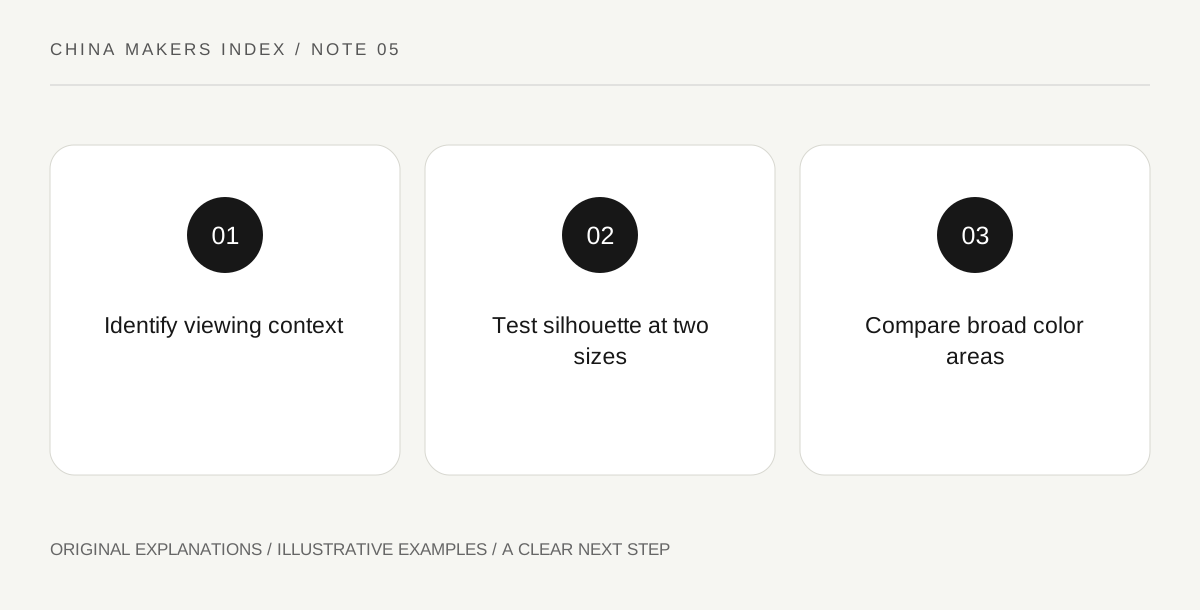
Original explanatory diagram. Read the full method and limitations below.
Identify an architectural-scale question
Beijing’s official cultural account presents liuli as a traditional glazed craft involving shaping and kiln work. Use the particular interpreted example to establish its context, then ask where it was intended to be seen. A small souvenir and an architectural ornament may share a broad craft name while making different demands on scale. Do not treat the handheld version as a complete explanation of the larger object’s function. Begin with the object’s recorded purpose and viewing position rather than assuming every detailed surface was designed for close inspection.
Make two drawings at different sizes
Create an original creature-like silhouette on ordinary paper, using a broad body, an upright feature and a few clearly separated projections. Draw it once large and once very small. Notice which features survive the size change and which merge or disappear. This is a graphic analogy for legibility, not a traditional design or a claim that the historical maker used the same exercise. The small version helps you see why an apparently exaggerated contour can communicate more effectively at a distance than many delicate internal lines.
Give surface color a separate test
Add two or three large color areas to the paper design and then compare them with a version filled with tiny alternating marks. Ask what can still be distinguished when you view the page from farther away. Do not infer glaze chemistry, firing conditions or historical color symbolism from that comparison. It studies perception, while the actual material process requires its own source and specialist instruction. When looking at the documented object, keep the identified glaze information separate from your observation of how color organizes the visible form.
Write a caption with a viewing position
Finish with a caption that names the object, the documented craft context and the position from which you studied it. A photograph taken at eye level in a museum may reveal details that an architectural setting would conceal. Both views are useful when their differences are acknowledged. The paper exercise can help you explain why silhouette matters without claiming to reconstruct the original viewer’s entire experience. It also encourages a more thoughtful workshop question about how makers adapt familiar forms for different scales and settings.
Illustrative design exercise
Illustrative silhouette test: a learner invents a compact animal form with one high projection and a stepped back. At small size, the projection remains readable while tiny drawn fur marks disappear. Broad color areas survive better than a dense pattern. The learner uses the result to ask about a documented glazed ornament’s intended viewing distance, keeping the paper study separate from technical ceramic claims.
Questions that come up
Does a bright surface reveal the glaze recipe?
No. Color appearance alone cannot establish formulation or firing. Use the actual craft record for material and process information.
Why study a museum object at more than one distance?
A close view reveals detail while a wider view reveals overall legibility. Comparing them can show which design decisions remain visible at different scales.
References and scope
These sources support the factual background. Examples and exercises are original illustrative teaching material. References do not imply endorsement.
- Beijing magazine, July 2025: Liuli craft account — The named Beijing glazed craft, shaping and kiln-work context; original distance-legibility exercise.