Sugar painting: plan the line budget with a pen
A fluent sugar-painting demonstration can make a complex image appear effortless. Study the design problem through a pen exercise: decide which lines are essential to recognition and which only add visual noise. This safe analogy develops attention to sequence and economy without giving instructions for handling hot sugar or claiming to reproduce an artisan’s method.
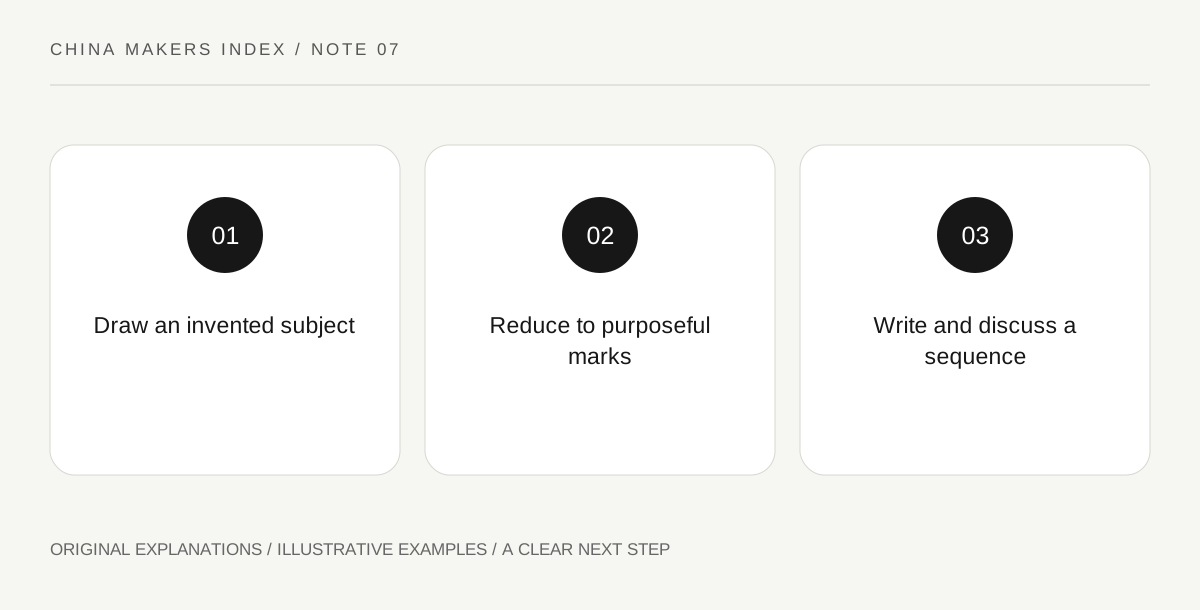
Original explanatory diagram. Read the full method and limitations below.
Recognize the demonstrated medium
Beijing’s official account describes artisans making sugar images through flowing lines and a wide range of subjects. The documented practice supplies a useful design question: how can a recognizable form emerge from a limited sequence of marks? Do not reduce the real craft to the pen exercise that follows. Material behavior, tool control and experienced timing belong to the artisan’s work. The drawing simply isolates a planning problem that a beginner can explore on ordinary paper without heat, cooking equipment or a specialist workspace.
Choose an invented subject with a clear outline
Draw a fictional fish-like creature using one broad body, a tail and a single distinguishing feature. Make the first version with as many marks as you want. Then redraw it using fewer lines, keeping only those that communicate the form. Compare what each removed mark was doing. A line budget is a self-imposed learning constraint, not a rule about traditional sugar painting. Its value lies in making you decide whether a mark supports recognition, connects elements or merely repeats information already supplied elsewhere in the drawing.
Add a sequence to the selected lines
Number the marks in an order that you could explain to another person. If the order requires returning repeatedly to one small area, ask whether a different arrangement is clearer. You do not need to force the design into a single unbroken stroke. That would be another constraint, and it may not serve the current exercise. The important lesson is that a finished image hides its making sequence. Writing the order makes your own decisions reviewable and helps you watch a real demonstration for transitions rather than only the final shape.
Watch an artisan without inventing a shortcut
At a permitted demonstration, notice where the maker begins, how they connect major parts and when small details appear. Ask questions at a suitable moment and respect the working area. Do not claim that your numbered pen sequence is the traditional method or that watching once makes you qualified to reproduce the process. A good caption identifies the actual craft and describes your separate paper study as an exploration of line economy. That preserves the interest of the analogy while leaving specialist material knowledge visible.
Illustrative design exercise
Illustrative line budget: a learner’s invented fish begins with fourteen marks. A second version uses eight, keeping the tail and one prominent fin while removing repeated internal lines. The learner numbers the remaining sequence and explains why each mark matters. During a later demonstration, they pay attention to the artisan’s transitions rather than assuming the eight-mark paper plan predicts the actual sugar process.
Questions that come up
Must every sugar image be a single unbroken line?
This article establishes no such universal rule. The original exercise concerns line economy, while the actual practice should be understood through a specific maker’s demonstration.
Does a simpler drawing prove greater skill?
No. The constraint is a learning tool. Skilled work can be complex or spare; the useful question is what each decision contributes to the particular design.
References and scope
These sources support the factual background. Examples and exercises are original illustrative teaching material. References do not imply endorsement.
- Beijing magazine: Chinese Dragons in Everyday Life, February 2024 — The documented sugar-painting medium, flowing line imagery and varied subjects; original pen analogy only.