A marbled fan: compare color distribution before judging the pattern
A marbled surface can look spontaneous while still presenting a composition that must work within an object’s shape. Use a documented lacquer-fan example to ask where color gathers and where the surface remains quiet. An original colored-paper exercise studies distribution without giving instructions for lacquer, solvents or specialist finishing materials.
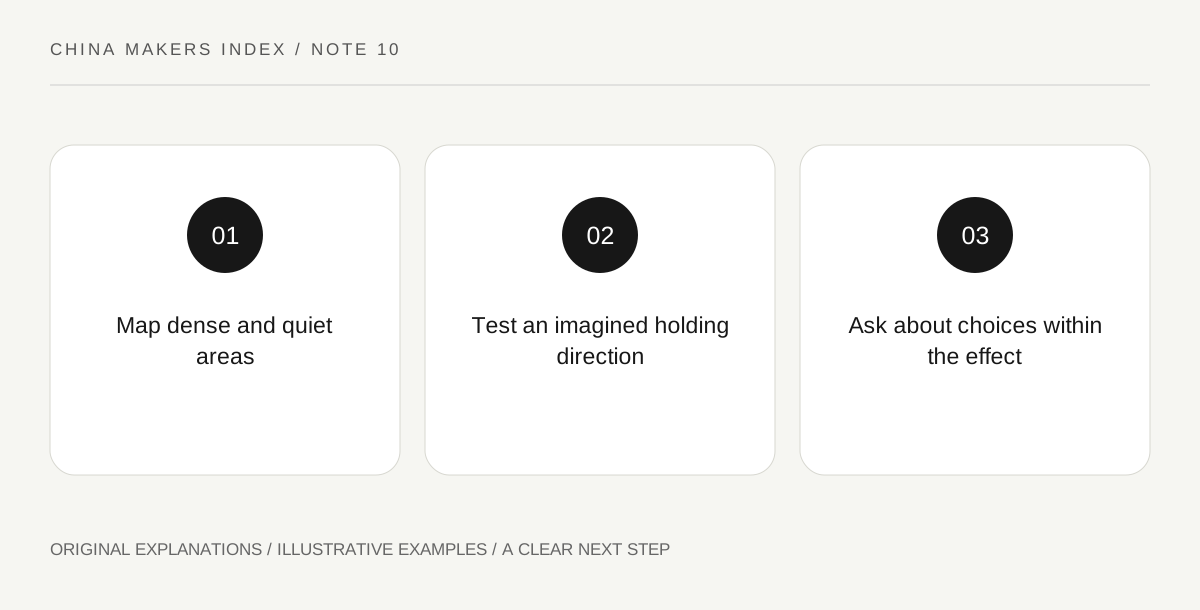
Original explanatory diagram. Read the full method and limitations below.
Name the observed effect precisely
Shanghai’s official craft account describes a fan with a marbled paint effect. Keep that surface description attached to the documented example. The visual effect alone does not establish every material or operation used in a product sold elsewhere. Ask a workshop or maker about the particular process if you want to understand it. This article focuses on composition: the relationship between denser and quieter areas within the fan outline, a question that can be explored safely without reproducing a chemical finish.
Use patches as an original analogy
Draw an invented fan-like outline on paper and place a few torn colored-paper patches within it. Try a cluster near one edge, a central cluster and a broad diagonal arrangement. Leave the patches loose until you have compared them. The exercise does not simulate the flow of actual lacquer or paint; it isolates color distribution. A large quiet area can change how the denser region is perceived. Describe the relationship before deciding which version you prefer, so your judgment has something more precise behind it than an immediate reaction to a favorite color.
Consider the object’s direction
Mark an imagined handle or holding point and ask how that orientation affects the composition. Turn the page and notice whether the color cluster now feels differently placed. This does not prove there is one correct orientation for every fan, but it reveals how an object differs from an unbounded abstract pattern. In a documented example, use the actual form and intended handling information. Do not force a display object open or rotate it without permission to test an idea that can be explored on your own paper.
Keep chance and choice in the same discussion
A maker may work with effects that cannot be predicted exactly, while still making choices about palette, timing, placement and selection. Ask about the choices in a particular demonstration instead of assuming that an irregular pattern means no skill was involved. Your paper study provides a vocabulary for that conversation: clustered, distributed, quiet area and directional emphasis. Finish with one observation and one question, labeling the study as an original composition exercise. It can deepen appreciation without pretending that torn paper teaches a traditional finish.
Illustrative design exercise
Illustrative distribution study: a learner arranges blue and cream paper patches in three fan-like outlines. The edge cluster leaves a broad quiet area, while the diagonal version emphasizes the imagined handle direction. The learner chooses one for a stated compositional reason and asks a workshop instructor how intentional choices interact with the real material’s less predictable effects.
Questions that come up
Does an irregular pattern mean it was made without decisions?
No. Irregular appearance alone does not tell you how much selection or control occurred. Ask the maker about the actual process and design choices.
Can ordinary paper teach lacquer handling?
No. The exercise studies composition only. Real materials, workspace requirements and finishing methods need suitable specialist instruction.
References and scope
These sources support the factual background. Examples and exercises are original illustrative teaching material. References do not imply endorsement.
- Shanghai: Explore traditional crafts at TOP Central Park — The documented marbled fan effect; all paper composition exercises are original and contain no lacquer procedure.